Short by design
Each Disaster David episode is a compact comic strip built around one accessibility failure, customer-journey problem, or painfully familiar digital experience.
 Read the full visual description of the Blindspot Digital Main logo
Visual description of the Blindspot Digital logo:
On a dark charcoal textured background, a white two-tier computer server forms the base of a branching digital network. A stylized white mobility cane rises from the centre, representing blindness, independent travel, and access for people who are blind or have low vision.
White and orange connection lines branch outward from the server. They connect to a website hierarchy diagram, abstract digital nodes and interface symbols, and an orange wheelchair accessibility symbol. Together, the connected elements represent digital systems engineered to include people with different disabilities.
Beneath the illustration, large white uppercase text reads “Blindspot Digital.” Smaller orange uppercase text reads “Engineering Inclusion.” A red tagline underneath reads, “We make sure your business isn’t blindsided.”
Accessibility education for real-world use
Blindspot Digital explains digital accessibility through practical examples, real user journeys, engineering context, and a little catastrophic humour.
The goal is simple: make accessibility easier to understand without reducing it to scanner scores, jargon, or checkbox compliance.
Featured series
He isn't even trying.
Disaster David is a visually impaired website user doing completely ordinary things: pressing Tab, zooming a page, using assistive technology, rotating a phone, filling out a form, or trying to buy a mug.
When a website is designed around assumptions instead of real users, those ordinary actions can have extraordinary results.
Each Disaster David episode is a compact comic strip built around one accessibility failure, customer-journey problem, or painfully familiar digital experience.
Every strip includes a complete written image description covering the important visual action, dialogue, sound effects, and punchline so the story does not depend on seeing the artwork.
The comedy is followed by a plain-language explanation of the real accessibility problem, why it matters to users, and what the failure means for the customer journey.
Disaster David — Episode 1
A website has been scanned, tested, and proudly declared “100% accessible.” Then David tries to make a completely ordinary purchase.
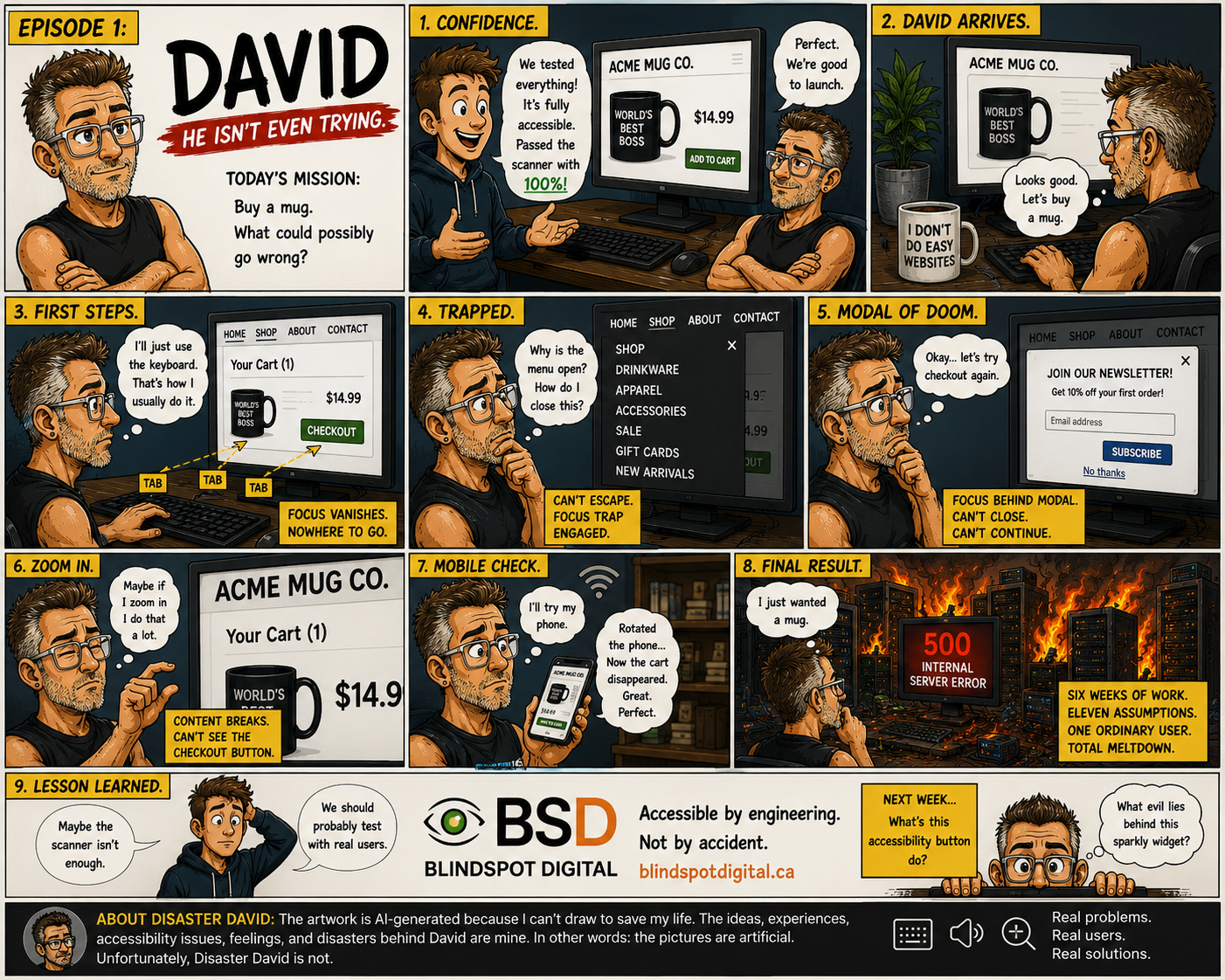
A multi-panel comic follows Disaster David, a visually impaired man with short dark brown hair that has gone noticeably gray early, especially at the sides and mixed through the top. He wears rectangular glasses, has short facial stubble, and wears a sleeveless black shirt.
Two developers proudly declare an online mug store ready to launch after an automated accessibility scanner reports a perfect score. David is not testing the website or trying to break it. He simply wants to buy a mug.
As he uses ordinary interactions, keyboard focus disappears, a menu traps him, a modal blocks the page, zooming causes important controls to vanish, and the mobile experience falls apart. The situation escalates into an absurd cartoon disaster: alarms sound, systems fail, and a server room is engulfed in flames beside a “500 Internal Server Error” display.
David stands amid the chaos, shrugs, and says: “I just wanted a mug.”
The final lesson is that automated scanning is useful, but a perfect scanner score does not prove that a real person can successfully use the website.
The joke is exaggerated. The accessibility barriers are not.
A control that works with a mouse may still be unreachable, confusing, or unusable from the keyboard.
Menus, dialogs, and other interactive components can trap focus, lose focus, or send users somewhere they did not expect.
Enlarging content should not make controls disappear or force a user to choose between reading the page and completing the task.
Changing orientation, screen size, or viewport should not destroy the customer journey.
Automated tools are useful, but they cannot determine every aspect of whether a real person can understand and complete a task.
Accessibility has to survive ordinary human behaviour, not merely satisfy a report.
The artwork is AI-generated because I can't draw to save my life. The ideas, experiences, accessibility issues, feelings, and disasters behind David are mine.
In other words: the pictures are artificial. Unfortunately, Disaster David is not.
Future episodes will live here as the series grows. Each strip will keep the same accessible structure: comic, complete image description, and a short explanation of the real accessibility issue behind the joke.
Learn how structural accessibility barriers can interrupt buying, booking, contacting, applying, and other ordinary customer journeys.
Read the accessibility guideSee how automated analysis, engineering review, remediation, and verification fit together.
Explore the methodologyWhen education turns into a real accessibility problem, Blindspot Digital can help identify, remediate, and verify the underlying barriers.
View accessibility services